Kit desk · chart page
SEER and SCOP explained, with every label threshold
SEER and SCOP explained in one line: an A+++ split must reach a seasonal SEER of 8.50 and a SCOP of 5.10, and wall splits we read declare SEER 7.40–10.5.
By the Cooler Indoors desk · figures checked · 4 charts · sources · methods
SEER and SCOP, explained simply, are seasonal efficiency ratios. SEER compares the cooling a unit delivers with the electricity it uses across a whole cooling season; SCOP does the same for heating across an average heating season. The GB energy label turns each ratio into a letter from A+++ down to G.
What do SEER and SCOP actually measure?
Both measure heat moved per unit of electricity, averaged over a season rather than taken at one test point. A SEER of 7.40 means roughly 7.4 units of cooling for every unit of electricity over the modelled season. The label covers mains-powered air conditioners rated up to 12 kW, and the SCOP on it is for the "average" heating season. For both ratios, a higher number is better: the unit moves more heat for each kilowatt-hour you pay for, which is why the top classes sit at the top of the scale.
EER and COP are the single-point versions, measured at fixed rated conditions. Portable units are labelled on those rather than on seasonal figures, which is why the two kinds of label cannot be compared letter for letter.
What SEER does each energy label class need?
An A+++ cooling class needs a SEER of 8.50 or more. Each step down the scale lowers the bar, until anything under 2.60 lands in G.
Source: legislation.gov.uk, Regulation (EU) No 626/2011, Annex II, Table 1 · checked 29 October 2026
How we read this Lower bound of each cooling class for split and other non-ducted units. Class G has no lower bound, so it has no column.
Show the numbers
| Label | SEER | Note |
|---|---|---|
| A+++ | 8.50 | |
| A++ | 6.10 | |
| A+ | 5.60 | |
| A | 5.10 | |
| B | 4.60 | |
| C | 4.10 | |
| D | 3.60 | |
| E | 3.10 | |
| F | 2.60 |
The steps are uneven. A++ spans a wide band from 6.10 to just under 8.50, so two A++ units can differ a lot; the declared SEER tells you more than the letter.
What SCOP does each energy label class need?
For heating, A+++ starts at a SCOP of 5.10, and G covers anything below 1.90.
Source: legislation.gov.uk, Regulation (EU) No 626/2011, Annex II, Table 1 · checked 29 October 2026
How we read this Lower bound of each heating class for the average season. A SCOP and a SEER of the same size do not earn the same letter, so read each against its own scale.
Show the numbers
| Label | SCOP | Note |
|---|---|---|
| A+++ | 5.10 | |
| A++ | 4.60 | |
| A+ | 4.00 | |
| A | 3.40 | |
| B | 3.10 | |
| C | 2.80 | |
| D | 2.50 | |
| E | 2.20 | |
| F | 1.90 |
What SEER and SCOP do real wall splits declare?
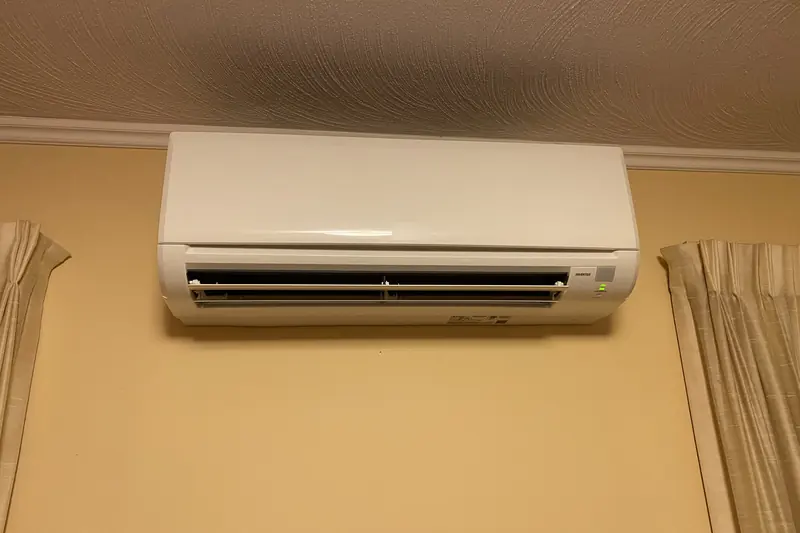
The wall splits on our list declare SEER from 7.40 to 10.5 and SCOP from 4.40 to 5.2. Fujitsu's ASEH09KNCA, a 2.5 kW model, declares SEER 7.40 and SCOP 4.40, which makes it A++ for cooling and A+ for heating. Mitsubishi Electric's MSZ-LN range declares SEER 7.5 to 10.5 and SCOP 4.6 to 5.2, with its smallest models scoring highest.
Source: Mitsubishi Electric UK, MSZ-LN R32 product information · checked 29 October 2026
How we read this Maker-declared seasonal figures from spec sheets (the Fujitsu value from its own UK product page), not our measurements. Five models are a sample, not the market.
Show the numbers
| Label | SEER | Note |
|---|---|---|
| Mitsubishi MSZ-LN25 (2.5 kW) | 10.5 | |
| Mitsubishi MSZ-LN35 (3.5 kW) | 9.5 | |
| Mitsubishi MSZ-LN50 (5.0 kW) | 8.5 | |
| Mitsubishi MSZ-LN60 (6.1 kW) | 7.5 | |
| Fujitsu ASEH09KNCA (2.5 kW) | 7.40 |
Why does one unit show different EER, SEER and SCOP figures?
Because each number answers a different question. Fujitsu's sheet for the ASEH09KNCA lists a rated EER of 3.38 next to a SEER of 7.40, and a rated COP of 4.00 next to an average-season SCOP of 4.40 and a warmer-climate SCOP of 5.90.
Source: Fujitsu General UK, ASEH09KNCA specifications · checked 29 October 2026
How we read this All five figures from one product page. Rated values come from a single test point and seasonal ones from modelled weather, so they are not interchangeable.
Show the numbers
| Label | ratio | Note |
|---|---|---|
| EER (rated) | 3.38 | |
| SEER | 7.40 | |
| COP (rated) | 4.00 | |
| SCOP, average climate | 4.40 | |
| SCOP, warmer climate | 5.90 |
The same page gives annual energy figures of 118 kWh for cooling and 763 kWh for average-climate heating. Those are the label's reference numbers; your own use will be higher or lower. Turning efficiency into pounds per hour is worked through on our running costs page.
Can a portable's label be compared with a split's?
No. Portables with one or two ducts sit on a separate table built on rated EER, where A+++ starts at 4.10, while a split's A+++ needs a seasonal 8.50. The letters share a name but not a test basis; the two families are set side by side on our kit comparison.
| Model | Nominal cooling (kW) | SEER | SCOP (average) | Label class, cool / heat | Source |
|---|---|---|---|---|---|
| Fujitsu ASEH09KNCA | 2.5 | 7.40 | 4.40 | A++ / A+ | Fujitsu UK |
| Mitsubishi MSZ-LN25VG3 | 2.5 | 10.5 | 5.2 | A+++ / A+++ | Mitsubishi Electric UK |
| Mitsubishi MSZ-LN35VG3 | 3.5 | 9.5 | 5.1 | A+++ / A+++ | MSZ-LN spec sheet |
| Mitsubishi MSZ-LN50VG3 | 5.0 | 8.5 | 4.6 | A+++ / A++ | MSZ-LN spec sheet |
| Mitsubishi MSZ-LN60VG3 | 6.1 | 7.5 | 4.6 | A++ / A++ | MSZ-LN spec sheet |
| Label scope | up to 12 kW | Reg. 626/2011 Art. 1 | |||
| Class thresholds | A+++ from 8.50 | A+++ from 5.10 | Reg. 626/2011 Annex II |
Questions this data raises
Does a higher SEER always mean a cheaper bill?
For the same cooling over the same season, a higher SEER means less electricity. Your actual bill depends on how many hours the unit runs, the room and your tariff.
Why does my heat pump's spec sheet list two SCOP figures?
Makers can declare SCOP for more than one climate. Fujitsu gives 4.40 for the average season and 5.90 for a warmer one; the label class uses the average figure.
What does BS EN 14825 mean on a spec sheet?
It is the test standard named against the seasonal figures. Mitsubishi Electric's MSZ-LN sheet prints its SCOP and SEER under that heading, SCOP first.
Are air conditioners above 12 kW labelled?
Not under this regulation, which covers mains-powered units rated at 12 kW or less. Larger systems fall outside the A+++ to G scale shown here.
Sources for this page
- legislation.gov.uk, Regulation (EU) No 626/2011, Annex II, Table 1 legislation.gov.uk
- Mitsubishi Electric UK, MSZ-LN R32 product information les.mitsubishielectric.co.uk
- Fujitsu General UK, ASEH09KNCA specifications generalww.com
- MSZ-LN spec sheet library.mitsubishielectric.co.uk
- Reg. 626/2011 Art. 1 legislation.gov.uk
All checked 29 October 2026. How we choose and read sources: Methods & sources.