Kit desk · chart page
Single hose vs dual hose portable air conditioners
Single hose vs dual hose portable units face identical GB cooling class lines (A+++ from an EER of 4.10), yet only the single hose pulls warm outdoor air indoors.
By the Cooler Indoors desk · figures checked · 3 charts · sources · methods
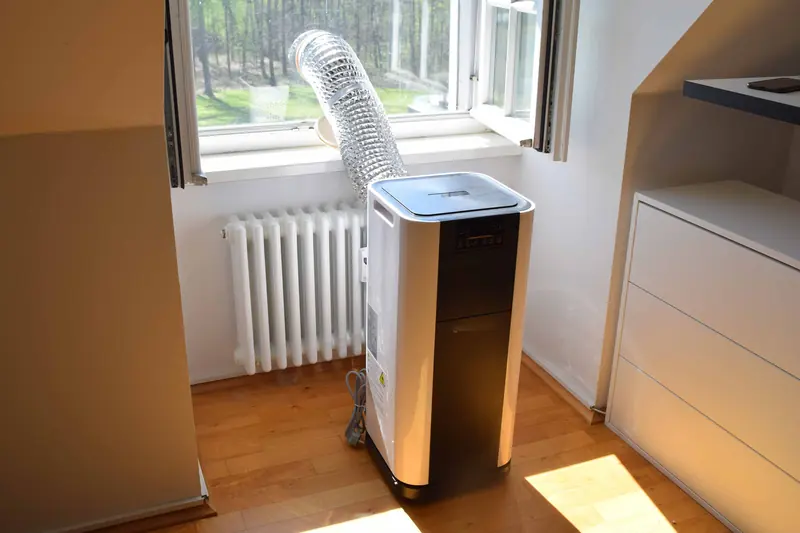
In the single hose vs dual hose portable air conditioner question, the hose count decides where the unit finds the air it uses to cool its own hot coil. A single-hose model takes that air from your room and blows it outside; a dual-hose model draws it from outdoors through a second duct and sends it straight back out. That one difference shapes how much cooling actually reaches you.
What is the difference between a single hose and a dual hose portable?
It is where the condenser air comes from. GB law defines a single-duct unit as one whose condenser intake air is taken from the room it stands in and discharged outside that room. A double-duct unit has a second hose, so the air it heats and expels starts and finishes outdoors.
The US Department of Energy draws the same line in its test method, Appendix CC: a single-duct unit draws all of its condenser inlet air from the conditioned space, and a dual-duct unit takes some or all of it from outside.
Why does a single hose portable cool less than the box suggests?
Every litre of air it pushes out of the window has to be replaced, and the replacement seeps in from outdoors through doors, vents and gaps. On a hot afternoon that incoming air is warmer than the room you are trying to cool. The DOE's 2023 test procedure, published in May that year, therefore adjusts a portable's measured capacity for two losses: outdoor air infiltrating the room, and heat given off by the hot exhaust duct.
Source: US DOE, test procedure for portable air conditioners, 88 FR 31102 · checked 29 October 2026
How we read this US test conditions, shown in °C. They explain why leaking outdoor air matters, but they give no GB figure and no single penalty percentage.
Show the numbers
| Label | °C | Note |
|---|---|---|
| Indoor room | 26.7° | |
| Outdoor, hot condition | 35.0° | |
| Outdoor, milder condition | 28.3° |
We found no primary source that puts one percentage on the single-hose penalty, so we do not quote one. The direction is not in doubt, though: a dual-hose unit or a split system avoids most of that warm-air leak.
How does the GB energy label grade single hose and dual hose units?
For cooling it uses the same thresholds for both. Table 2 of the label regulation sets A+++ at a rated EER of 4.10 or more, and class C at 2.10 to under 2.40, for single and double duct alike. That EER is measured at fixed rated conditions and carries no US-style infiltration adjustment, so an A+ single-hose label tells you nothing about the warm air it draws in.
Source: legislation.gov.uk, Regulation (EU) No 626/2011, Annex II, Table 2 · checked 29 October 2026
How we read this Lower bound of each cooling class. Classes D to G were not transcribed in our research, so they are left off rather than guessed.
Show the numbers
| Label | EER | Note |
|---|---|---|
| A+++ | 4.10 | |
| A++ | 3.60 | |
| A+ | 3.10 | |
| A | 2.60 | |
| B | 2.40 | |
| C | 2.10 |
Heating is where the two types part company. A double-duct unit needs a rated COP of 4.60 to earn A+++, while a single-duct unit gets the same class at 3.60.
Source: legislation.gov.uk, Regulation (EU) No 626/2011, Annex II, Table 2 · checked 29 October 2026
How we read this Lower bound of each heating class. A lower bar for the same letter means the label asks less of a single duct; it does not mean a single duct heats better.
Show the numbers
| Label | COP | Note |
|---|---|---|
| Double duct, A+++ | 4.60 | |
| Single duct, A+++ | 3.60 | |
| Double duct, A+ | 3.60 | |
| Single duct, A+ | 2.60 | |
| Double duct, C | 2.40 | |
| Single duct, C | 1.80 |
Is a dual hose portable worth it over a single hose?
If a portable is the only option, the dual-hose design removes the main reason portables disappoint, because it stops pulling condenser air out of the room you are cooling. Beyond that, the label class and the maker's rated EER are the fairest guide, and both types are tested on the same cooling scale.
Refrigerant rules apply equally to both. Since GB bans HFCs with a global warming potential above 150 in movable air conditioning, R32 at 675 cannot be used in a new portable; propane (R290) at 3 sits well below the cap. The wider comparison is on our refrigerant page.
Keep windows shut while any air conditioner runs, as UKHSA advises for cooled rooms, and seal the window kit around the hose so the opening stays small.
When is a split system better than either kind of portable?
When you want to cool the same room every summer and can site an outdoor unit. A split carries heat outdoors through sealed refrigerant pipes, so there is no hose and no infiltration at all. Fitting one is F-gas work for a certified engineer and company, with any new circuit wired by a registered electrician. We compare the two families in split or portable.
Tax treatment differs too: a portable bought on its own is charged VAT at the standard 20%.
| Point | Single hose | Dual hose | Source |
|---|---|---|---|
| Where condenser air comes from | The room being cooled | Outdoors, through a second duct | Reg. 626/2011 Art. 2 |
| Warm outdoor air drawn in through gaps | Yes, it replaces the exhausted air | Mostly avoided | DOE test procedure |
| GB cooling class A+++ | EER 4.10 or more | EER 4.10 or more | Annex II |
| GB heating class A+++ | COP 3.60 or more | COP 4.60 or more | Annex II |
| Refrigerant cap (GB, HFCs) | GWP 150 | GWP 150 | GOV.UK F-gas bans |
| VAT when bought without installation | 20% | 20% | HMRC 708/6 |
| Keep windows closed while cooling | Yes | Yes | UKHSA guidance |
Questions this data raises
Can I turn a single hose portable into a dual hose one?
We found no primary source covering conversions, and the label class applies to the unit as built. Check the maker's manual; if it offers no second-hose kit, treat the unit as single hose.
Does a dual hose portable need an F-gas engineer to set up?
No. A portable is a self-contained unit that arrives sealed, so setting it up involves no refrigerant work. Any repair that opens the refrigerant circuit is a job for a certified engineer.
What do the 35.0°C and 26.7°C figures on US test reports mean?
They are the outdoor and indoor conditions in the US DOE portable test. GB labels use their own rated conditions, so a US capacity figure and a GB EER cannot be lined up.
Why is the single duct heating threshold lower than the double duct one?
The label regulation simply sets a different scale for each type in heating mode. It reflects how the two designs are tested, not a sign that single ducts are better heaters.
Sources for this page
- US DOE, test procedure for portable air conditioners, 88 FR 31102 federalregister.gov
- legislation.gov.uk, Regulation (EU) No 626/2011, Annex II, Table 2 legislation.gov.uk
- Reg. 626/2011 Art. 2 legislation.gov.uk
- GOV.UK F-gas bans gov.uk
- HMRC 708/6 gov.uk
- UKHSA guidance gov.uk
All checked 29 October 2026. How we choose and read sources: Methods & sources.