Rules desk · chart page
Air conditioning noise and neighbours: the 37 dB rule
Air conditioning noise at a neighbour's window must calculate to 37 dB(A) or less for permitted development in England and Wales, while outdoor units declare 56–65 dB(A) sound power.
By the Cooler Indoors desk · figures checked · 4 charts · sources · methods
Air conditioning noise from a neighbour's outdoor unit is one thing the planning rules put a hard number on. In England, and in Wales since June 2026, an outdoor unit only counts as permitted development if a set calculation shows 37 dB(A) or less at the nearest neighbour's window or door. The figures on a spec sheet are much higher, and the gap between them is the whole story.
Source: Mitsubishi Electric UK, MSZ-LN R32 product information · checked 29 October 2026
How we read this Declared sound power from the makers' sheets (Fujitsu figure from its UK product page). Sound power describes the source, not what anyone hears at a given spot, so these numbers cannot be compared directly with the 37 dB limit.
Show the numbers
| Label | dB(A) | Note |
|---|---|---|
| Fujitsu ASEH09 | 56 | |
| Mitsubishi LN25 | 60 | |
| Mitsubishi LN35 | 61 | |
| Mitsubishi LN50 | 64 | |
| Mitsubishi LN60 | 65 | Largest model, loudest |
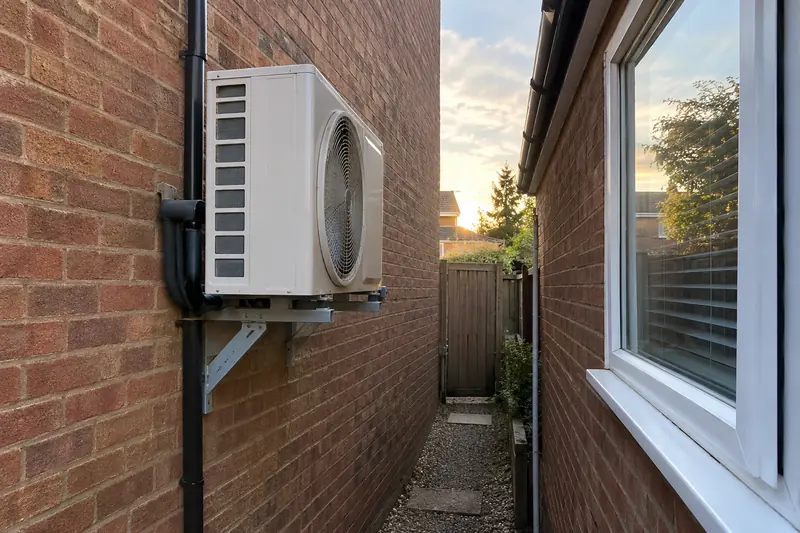
How loud can an outdoor unit be next to a neighbour's house?
The calculated sound pressure must be 37.0 dB(A) or lower at an assessment position 1 m outside the centre of a neighbour's habitable-room window or door. That limit comes from MCS 020(a), which the planning order names as the standard every permitted development install must meet. Wales adopted the same test on 1 June 2026, as MCS noted when the Welsh rules changed.
It is a desk calculation, not a reading taken in the garden. It also does not settle planning on its own: MCS states that passing the test "on its own does not bestow permitted development rights", because size, siting and building type still apply. Our rundown of those siting conditions covers each nation.
What is the difference between sound power and sound pressure?
Sound power is the total acoustic energy the unit gives out, wherever you stand. Sound pressure is what reaches a particular point, so it falls with distance and changes with walls and fences. Spec sheets often list both, which is why a single outdoor unit can carry two quite different dB(A) figures. Fujitsu's UK listing for the ASEH09KNCA, for example, gives 44 dB(A) pressure and 56 dB(A) power for the same outdoor unit in cooling, and Mitsubishi's MSZ-LN sheet climbs to 65 dB(A) power on its largest size.
Source: Fujitsu General UK, ASEH09KNCA specifications · checked 29 October 2026
How we read this Each bar runs from the cooling to the heating figure as declared (Mitsubishi LN figures from its product sheet). Neither maker states the measuring distance in the text we read, so these are not "dB at 1 m" values.
Show the numbers
| Label | Low | High | Note |
|---|---|---|---|
| Fujitsu ASEH09 | 44 | 45 | |
| Mitsubishi LN25 | 46 | 49 | |
| Mitsubishi LN35 | 49 | 50 | |
| Mitsubishi LN50 | 51 | 54 | |
| Mitsubishi LN60 | 55 | 55 |
How does the MCS 020(a) noise calculation work?
The installer starts with the maker's A-weighted sound power, then applies a directivity factor for how many hard surfaces sit close to the unit. Distance to the assessment position is subtracted next, followed by any correction for a solid barrier between unit and window. The result must not exceed 37.0 dB(A); separate tables handle sites with two units.
The MCS consultation response explains why the number fell. The old method compared the unit with an assumed 40 dB(A) of background noise against a 42 dB(A) ceiling; the new one drops the background step, giving an overall limit of 37 dB.
On video: Permitted development and sound output calculations on an Air Source Heat Pump | ASHP Guide
“Permitted development and sound output calculations on an Air Source Heat Pump | ASHP Guide”, a video from the Baxi - sustainable heating and hot water solutions channel on YouTube. A Baxi trainer explains that MCS replaced the old 42 dB limit with the 37 dB permitted-development threshold, using a new 3D method and MCS's free online calculator. It is their video, not ours, and it loads from YouTube only when you press play.
Source: MCS 020 consultation response, November 2024 · checked 29 October 2026
How we read this All three are calculation inputs or limits, not field measurements. Northern Ireland's 2023 rules refer to the prescribed noise standard of the time.
Show the numbers
| Label | dB(A) | Note |
|---|---|---|
| Old assumed background | 40 | |
| Old MCS 020 limit | 42 | Scotland and NI still use it |
| MCS 020(a) limit | 37 | England; Wales from 1 June 2026 |
Does air conditioning noise matter at night?
Yes, mainly for bedrooms. Building regulations for new homes in England assume people will shut bedroom windows overnight if indoor noise rises past 40 dB as an eight-hour average, or peaks above 55 dB more than ten times a night, according to Approved Document O. A condenser that keeps a neighbour's window shut on a warm night defeats the point of ventilation.
Source: Approved Document O, para 3.3 · checked 29 October 2026
How we read this These are indoor bedroom levels used to design new homes in England, not a limit on heat pumps. We show them as context for siting an outdoor unit near sleeping rooms.
Show the numbers
| Label | dB | Note |
|---|---|---|
| Average, 11pm to 7am | 40 | |
| Peak, more than 10 times a night | 55 |
Where should an outdoor unit go to keep the peace?
Distance and screening do most of the work in the calculation, so the quietest choice is usually the spot furthest from any neighbouring bedroom with a solid wall or fence in between. Each extra hard surface close to the unit, such as a corner or alcove, raises the directivity factor and pushes the result up. Ask the installer to show you the figures for each neighbouring window.
| Model | Cooling capacity | Sound pressure, dB(A) | Sound power, dB(A) |
|---|---|---|---|
| Fujitsu ASEH09KNCA | 2.5 kW | 44 cooling, 45 heating | 56 |
| Mitsubishi MSZ-LN25 | 2.5 kW | 46 cooling, 49 heating | 60 |
| Mitsubishi MSZ-LN35 | 3.5 kW | 49 cooling, 50 heating | 61 |
| Mitsubishi MSZ-LN60 | 6.1 kW | 55 cooling, 55 heating | 65 |
Questions this data raises
Is a spec sheet figure of 45 dB(A) already over the 37 dB limit?
Not necessarily. The 37 dB limit applies at 1 m outside a neighbour's window after distance and barriers are taken into account, while the spec figure describes the unit itself.
Do two outdoor units have to share the 37 dB allowance?
Yes. MCS 020(a) has separate tables for one and two units, and the combined result at each assessment position must still be 37.0 dB(A) or less.
Does the noise test apply if my installer is not MCS certified?
Yes. MCS says compliance with MCS 020(a) under permitted development applies whether the installation is MCS certified or not.
Which noise rule applies in Scotland and Northern Ireland?
MCS says both still use the older MCS 020 method with its 42 dB(A) limit, or an equivalent; Northern Ireland's 2023 rules refer to that prescribed standard. Check with the local council before choosing a spot.
Sources for this page
- Mitsubishi Electric UK, MSZ-LN R32 product information les.mitsubishielectric.co.uk
- MCS 020(a) mcscertified.com
- MCS noted mcscertified.com
- Fujitsu General UK, ASEH09KNCA specifications generalww.com
- MCS consultation response mcscertified.com
- Approved Document O assets.publishing.service.gov.uk
- 2023 rules legislation.gov.uk
All checked 29 October 2026. How we choose and read sources: Methods & sources.