Heat desk · chart page
How to keep your house cool without AC
To keep a house cool without AC, UKHSA and the NHS advise shading sunny windows by day, opening windows at night, and using fans only while the air is below 35°C.
By the Cooler Indoors desk · figures checked · 3 charts · sources · methods
How to keep a house cool without AC comes down to three things official advice agrees on: stop the sun getting in, let cooler night air through, and use fans only while the air is below 35°C. Most English households who overheat already do some of this, but not always in the right order.
Source: MHCLG, English Housing Survey 2024 to 2025: weather resilient homes · checked 29 October 2026
How we read this Base is the roughly 3 million English households who reported overheating; people could give more than one answer. The 7% is a behaviour, not the share of homes that own an air conditioner.
Show the numbers
| Label | % | Note |
|---|---|---|
| Open the windows | 90% | Most common |
| Close shutters, curtains or blinds | 75% | |
| Switch on a fan | 59% | |
| Switch on an air conditioner | 7% | |
| Unroll an awning or canopy | 3% |
What is the fastest way to cool a hot house?
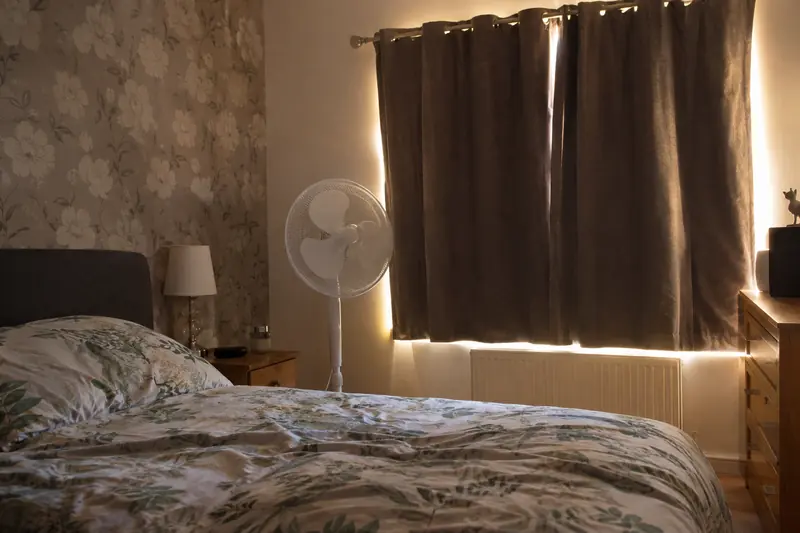
Block the sun before it reaches the glass, then ventilate when the outside air is cooler. UKHSA's Beat the heat advice says to close blinds and curtains on windows in direct sunlight during the day, and to open windows when the air feels cooler outside than in, for example at night, so air can flow through.
The NHS heatwave page gives the same routine, collected with other material in UKHSA's hot weather and health collection: keep windows, curtains and blinds closed by day and open them at night once the temperature outside has dropped. The order matters. Opening every window at 3pm on a 30°C afternoon lets hotter air in.
UKHSA's guidance for health and care staff adds a timing tip: close and shade windows very early in the morning, before heat builds up. Turning off lights and electrical equipment not in use, and checking the heating is off, removes small but steady sources of heat.
Do fans actually help in a heatwave?
Yes, up to a point. UKHSA and the NHS both say electric fans help while the air temperature is below 35°C. Above that, UKHSA's professional guidance warns that fans can raise body temperature, because they blow air hotter than the skin across it. UKHSA also says not to aim a fan straight at your body, as this can lead to dehydration.
Source: UKHSA, Supporting vulnerable people before and during hot weather: healthcare professionals · checked 29 October 2026
How we read this Both figures come from UKHSA guidance written for health and care staff; the 35°C fan limit also appears in UKHSA's and the NHS's public advice. They are guidance thresholds, not legal limits.
Show the numbers
| Label | °C | Note |
|---|---|---|
| A cool room, ideally below | 26° | Target |
| Fans help only below | 35° | Above this, fans can heat you |
In most of the UK, most of the time, 35°C is not reached, so a fan is a sensible first tool. On record-breaking days, such as 19 July 2022, it has been passed outdoors, and that is when moving to the coolest room matters more than the fan.
Source: Met Office, UK climate extremes · checked 29 October 2026
How we read this Highest daily maximum ever recorded in each nation, measured outdoors in the shade. Indoor temperatures depend on the building, so this shows when the fan rule can bite, not what any room reached.
Show the numbers
| Label | °C | Note |
|---|---|---|
| England (Coningsby, 2022) | 40.3° | Above 35°C |
| Wales (Hawarden Airport, 2022) | 37.1° | Above 35°C |
| Scotland (Charterhall, 2022) | 34.8° | |
| Northern Ireland (Castlederg, 2021) | 31.3° |
Which room should you sleep in during hot weather?
The coolest one you have, which is usually on a lower floor and away from windows that took the afternoon sun. UKHSA suggests moving to a cooler part of the house, especially for sleeping. Top-floor rooms are among the hardest to keep cool, a point covered on our overheating figures page.
What longer-term changes keep a house cooler?
External shading does the most because it stops heat before it reaches the glass. UKHSA's keep-cool checklist recommends internal blinds or curtains, and says external shutters, roller blinds or awnings are also very effective. It notes that plants outside south-facing windows can give shade too. Only 3% of overheating households used an awning in 2024, so there is room to do more here.
On video: Expert Comment: How to keep your house cool during a heatwave?
“Expert Comment: How to keep your house cool during a heatwave?”, a video from the Loughborough University PR - Expert Comment channel on YouTube. A Loughborough University healthy-buildings lecturer gives the core no-AC routine: keep windows shut in the hot day, ventilate at night, use light-coloured blinds on the sunny side, and consider external shading. It is their video, not ours, and it loads from YouTube only when you press play.
| Step | When | What the advice says |
|---|---|---|
| Close curtains or blinds on sunny windows | Daytime, from early morning | UKHSA and NHS: keep direct sun out |
| Open windows for a through-draught | When outside is cooler, often at night | UKHSA: only if it is safe to do so |
| Use an electric fan | Air below 35°C | UKHSA and NHS: do not aim it straight at your body |
| Sleep in the coolest room | Hot nights | UKHSA: move to a cooler part of the house |
| Switch off heat sources | All day | UKHSA: heating off, unused lights and equipment off |
| Fit external shading | Before summer | UKHSA: shutters, roller blinds and awnings work well |
When should you check the forecast and alerts?
Before the heat arrives, so you can shade the house early. The Met Office calls it a heatwave when a place has at least three days in a row at or above its county's threshold. UKHSA's weather-health alerts run with the Met Office and give yellow, amber or red warnings, which are a good prompt to check on older relatives and neighbours.
When are low-cost steps not enough?
When someone in the home is at high risk or a room stays above 26°C night after night. UKHSA's hot weather and health guidance covers older people, young children and people with long-term conditions, who are most affected. Know the signs of heat exhaustion and heatstroke; heatstroke is an emergency, so call 999. The signs are listed on our heat deaths page.
If cooling is still needed, a fixed split unit is far more effective than a portable. A single-hose portable pulls warm outside air in through gaps to replace the air it blows out, so it delivers less cooling than its rating suggests. The trade-offs are on our split versus portable comparison.
Questions this data raises
Should I open windows during the day in a heatwave?
Not while it is hotter outside than in. The NHS advises keeping windows, curtains and blinds closed during the day and opening them at night once the air outside has cooled.
Is it safe to sleep with a fan on in hot weather?
UKHSA and the NHS say fans help while the air is below 35°C. UKHSA advises not pointing the fan straight at your body, as this can cause dehydration.
Do blackout curtains help keep a room cool?
UKHSA advises closing curtains and blinds on windows that get direct sun during the day, and says external shutters and awnings are also very effective. It does not single out blackout curtains, so we make no claim for them specifically.
Does a bowl of ice in front of a fan work?
We found no UKHSA or NHS advice on it, so we cannot say. The official advice is to shade windows, ventilate at night and use a fan only below 35°C.
Sources for this page
- MHCLG, English Housing Survey 2024 to 2025: weather resilient homes gov.uk
- Beat the heat advice gov.uk
- hot weather and health collection gov.uk
- UKHSA, Supporting vulnerable people before and during hot weather: healthcare professionals gov.uk
- Met Office, UK climate extremes metoffice.gov.uk
- at least three days in a row metoffice.gov.uk
- weather-health alerts gov.uk
- hot weather and health guidance gov.uk
All checked 29 October 2026. How we choose and read sources: Methods & sources.