Rules desk · chart page
Planning permission for air conditioning, nation by nation
Planning permission for air conditioning in England is usually not needed for a heat-and-cool unit up to 1.5 m³ on a house; cooling-only units fall outside those rights.
By the Cooler Indoors desk · figures checked · 3 charts · sources · methods
Whether you need planning permission for air conditioning in the UK depends on three things: which nation you live in, whether the unit can heat as well as cool, and the type of building. England and Wales now treat a reversible air-to-air heat pump much like any other air source heat pump. Scotland and Northern Ireland still write their rules around heating.
Source: legislation.gov.uk, GPDO 2015 Sch. 2 Part 14 Class G · checked 29 October 2026
How we read this Volumes are the permitted development maximum for the outdoor unit including any housing. Wales figures are from SI 2026/79, in force 1 June 2026. Scotland and Northern Ireland set no volume cap in the same way.
Show the numbers
| Label | m³ | Note |
|---|---|---|
| England house | 1.5 | |
| England block of flats | 0.6 | Smallest allowance |
| Wales house | 1.5 | |
| Wales block of flats | 1.0 |
Do you need planning permission for air conditioning in England?
Usually not, if the unit heats as well as cools and meets the conditions in Class G of the General Permitted Development Order. Since 29 May 2025 those conditions allow two outdoor units on a detached house and one on any other house or block of flats. Each must stay within the volume limits in the chart above and pass the MCS 020(a) noise calculation.
The 1 m gap from the boundary that used to apply has gone. MCS confirmed that units can now sit within 1 m of the property line, and that the noise test applies whether or not the installer is MCS certified.
Source: legislation.gov.uk, GPDO Part 14 Class G and SR 2023/95 · checked 29 October 2026
How we read this Counts are the most outdoor units allowed without an application. Scotland's single unit applies per building, flats included; the Northern Ireland rule covers houses only.
Show the numbers
| Label | units | Note |
|---|---|---|
| England detached | 2 | |
| England other house | 1 | |
| England flat block | 1 | |
| Wales detached | 2 | |
| Wales other | 1 | |
| Scotland | 1 | |
| N. Ireland house | 1 |
Why does a cooling-only unit lose its permitted development rights?
Because the English rule says the heat pump must not be "solely used for the purpose of cooling". A split unit that can run in heating mode counts as an air source heat pump; a cooling-only system does not. Wales has the same carve-out.
Two official sources read this differently. The Planning Portal says a cooling-only system needs a planning application. A June 2026 government blog says a small home installation usually does not, as long as it does not materially change the building's appearance. Ask your council's planning team before buying.
Where on the house can the outdoor unit go?
Not on a pitched roof, and on a flat roof it must be at least 1 m from the edge. Outside conservation areas it cannot sit above ground-floor level on a wall that faces a road. Inside a conservation area or World Heritage Site, a wall or roof fronting a highway is ruled out altogether.
Listed buildings and scheduled monuments are excluded completely. Owners of flats or listed homes face extra layers of consent, covered on our flats, leases and listed buildings page.
Source: MCS 020 a) Issue 1.1 · checked 29 October 2026
How we read this Both are calculated sound pressure limits at 1 m outside a neighbour's habitable-room window or door, not readings taken on site. The old method also assumed 40 dB(A) of background noise; the new one drops that step.
Show the numbers
| Label | dB(A) | Note |
|---|---|---|
| Old MCS 020 limit | 42 | Still used in Scotland and NI |
| MCS 020(a) limit | 37 | England, and Wales from June 2026 |
What are the rules in Wales, Scotland and Northern Ireland?
Wales changed its rules on 1 June 2026. Heating-and-cooling units now count, cooling-only units do not, and MCS 020(a) applies. The flat-block allowance is 1 m³ rather than England's 0.6 m³, set out in SI 2026/79.
Scotland's Circular 1/2024 allows one air source heat pump per building, used only for heating or hot water. Read literally, an air-to-air unit used for summer cooling sits outside that right. A wall-mounted unit may not stick out more than 1 m. The Scottish Government has consulted on change, but we found no new law.
Northern Ireland allows one unit on a house, at least 1 m from a neighbour's boundary and no more than 3 m high, under rules the Department for Infrastructure introduced in July 2023.
| Nation | Heat-and-cool unit covered? | Units allowed | Size or distance limit | Noise test |
|---|---|---|---|---|
| England | Yes; cooling-only no | 2 detached, otherwise 1 | 1.5 m³ house, 0.6 m³ flat block | MCS 020(a), 37 dB |
| Wales | Yes; cooling-only no | 2 detached, otherwise 1 | 1.5 m³ house, 1 m³ flat block | MCS 020(a) |
| Scotland | Heating or hot water only | 1 per building | Projects no more than 1 m | MCS 020 or equivalent |
| Northern Ireland | Must provide heat | 1, houses only | 1 m from boundary, 3 m high | MCS 020 or equivalent |
Is planning permission for air conditioning the only consent you need?
No. Permitted development only answers the planning question. Building regulations still apply to the electrical side, and refrigerant work is controlled by F-gas law; see who can install and wire a system. A neighbour may also raise noise, which is why the noise page explains the 37 dB calculation in detail.
What should you check before you buy?
Confirm with the installer that the model has a heating mode, that the outdoor unit and any cover stay under the volume limit, and that they have run the MCS 020(a) calculation for each neighbouring window. If any answer is unclear, or the home is listed or in a conservation area, contact the council's planning team before anything is fixed to the wall.
Questions this data raises
Does a wall-mounted condenser on the back of a semi in England need permission?
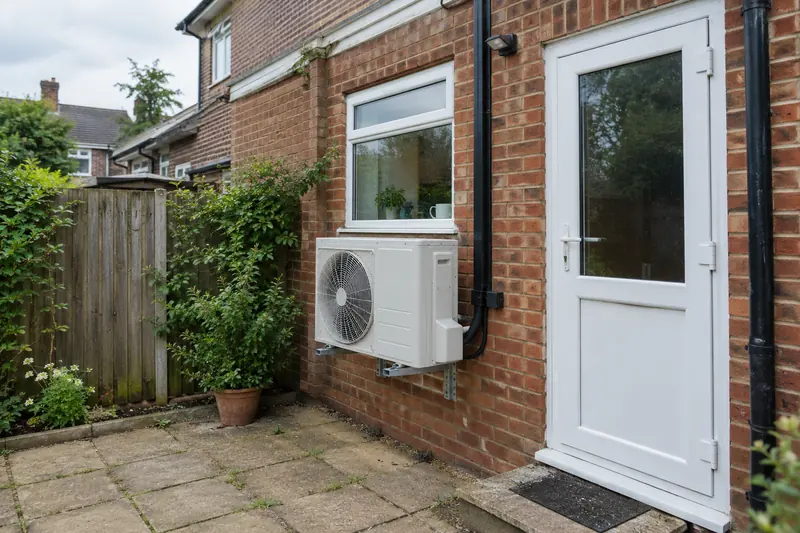
Usually not, if the system can heat as well as cool, the outdoor unit is 1.5 m³ or smaller and it passes the MCS 020(a) noise calculation. It must not go above ground-floor level on a wall facing a road.
Can I fit two outdoor units on a terraced house without applying?
No. The two-unit allowance in England and Wales applies only to detached houses; every other house is limited to one.
Does the 1 m boundary rule still apply in England?
No. It was removed on 29 May 2025, so a unit can sit closer than 1 m to the boundary if it meets the noise and siting conditions. Northern Ireland still keeps a 1 m gap.
Is an air-to-air heat pump permitted development in Scotland?
Only as a heating unit. Scotland's rule requires the heat pump to be used just for heating or hot water, so summer cooling falls outside it as written; check with the council.
Does Wales still keep a boundary distance for heat pumps?
The June 2026 Welsh changes deleted the old boundary condition, and MCS reads that as removing the distance rule. If the unit will sit close to a neighbour, confirm the position with the council.
Sources for this page
- legislation.gov.uk, GPDO 2015 Sch. 2 Part 14 Class G legislation.gov.uk
- MCS confirmed mcscertified.com
- legislation.gov.uk, GPDO Part 14 Class G and SR 2023/95 legislation.gov.uk
- Planning Portal interactive.planningportal.co.uk
- June 2026 government blog mhclgmedia.blog.gov.uk
- MCS 020 a) Issue 1.1 mcscertified.com
- 1 June 2026 gov.wales
- SI 2026/79 legislation.gov.uk
- Circular 1/2024 gov.scot
- Department for Infrastructure infrastructure-ni.gov.uk
All checked 29 October 2026. How we choose and read sources: Methods & sources.